 Contact Us | Sitemap |
||||
SysplexSystems ComplexIn 1990, IBM mainframe computers introduced the concept of a Systems Complex, commonly called a Sysplex, with MVS/ESA SPV4.1 in 1990. This allows authorized components in up to eight LPARs to communicate and cooperate with each other using the XCF protocol. A sysplex is a set of MVS systems communicating and cooperating with each other through certain multisystem hardware components and software services to processcustomer workloads. In a sysplex, your installation must designate one processor as the focal point for the entry and distribution of jobs and for the control of resources needed by the jobs. That processor, called the global processor, distributes work to the processors, called local processors In computing, a Parallel Sysplex is a cluster of IBM mainframes acting together as a single system image with z/OS. Used for disaster recovery, Parallel Sysplex combines data sharing and parallel computing to allow a cluster of up to 32 systems to share a workload for high performance and high availability.
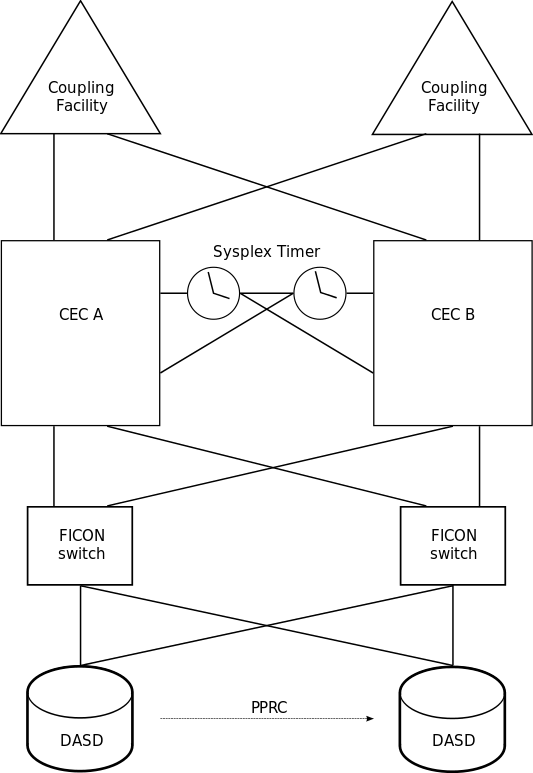
The Parallel Sysplex was introduced with the addition of the Coupling Facility (CF) with coupling links for high speed communication, with MVS/ESA V5.1 operating system support, together with the mainframe models in April 1994. The Coupling Facility (CF) may reside on a dedicated stand-alone server configured with processors that can run Coupling Facility control code (CFCC), as integral processors on the mainframes themselves configured as ICFs (Internal Coupling Facilities), or less common, as normal LPARs. The CF contains Lock, List, and Cache structures to help with serialization, message passing, and buffer consistency between multiple LPARs The primary goal of a Parallel Sysplex is to provide data sharing capabilities, allowing multiple databases for direct reads and writes to shared data. Read more at WikipediaIBM SysplexIn September 1990, IBM introduced the SYStems comPLEX, or sysplex, to help solve the complexity of managing multiple z/OS systems. A Sysplex is a collection of z/OS systems that cooperate using hardware and software functions to process work, providing improved growth potential and higher level of availability. The Sysplex architecture established the groundwork for simplified multi-system management through the Cross-System Coupling Facility (XCF) component of z/OS. XCF services allow authorized applications on one system to communicate with applications on the same system or on other systems. In a base sysplex, connectivity and communication between images is provided by high-speed interconnects called channel-to-channel (CTC) links. The disk couple data set, which is shared between all of the images, holds control information and provides a mechanism for monitoring the status of the images. When more than one server is involved, a common time source such as a Sysplex Timer or STP is required to synchronize the time on all systems. From a functionality perspective, the base sysplex did not change the clustering storage model. Data can be shared at the file level (data set) using z/OS Global Resource Serialization (GRS) locking services. What sysplex added was the following:
Parallel Sysplex AdvantagesThe IBM z/OS Parallel Sysplex is able to deliver on these promises, providing a cost-effective, flexible computing platform without peer. Through this new technology, the z/OS Parallel Sysplex provides you with a unique set of advantages: Ability to incorporate multiple hardware technology families into a single-image computing facility Wide range of price points, performance, and capacity No single points of failure Continuous availability for both planned and unplanned outages High-performance, scalable, read/write access to shared data across all systems in the sysplex Single-system image for systems and operations management Compatibility of existing application code Transparency to users and application developers Automatic, dynamic workload balancing across systems Incremental, granular growth with near linear scalability With Parallel Sysplex technology advances and business prospers. WebsiteWhat is a Parallel Sysplex?With IBM's Parallel Sysplex technology, you can harness the power of up to 32 z/OS systems, yet make these systems behave like a single, logical computing facility. What's more, the underlying structure of the Parallel Sysplex remains virtually transparent to users, networks, applications, and even operations. To accomplish all this, the z/OS Parallel Sysplex combines two critical capabilities: The first is parallel processing, and the second is enabling read/write data sharing across multiple systems with full data integrity. This combination makes the z/OS Parallel Sysplex unique among every other system, solution, or architecture available today. And, it results in a scalable growth path that extends beyond billions of instructions per second. |
Sponsored by 
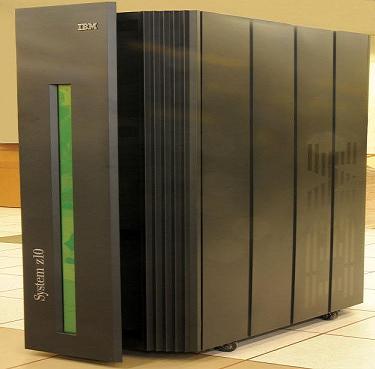 IBM z10 |
|||

| ||||
 Software Diversified Services, Minneapolis, MN USA